


Know when the payout clock actually starts
Cashout timing depends on operator approval as well as the later transfer by a bank, card, e-wallet or other provider.

Table of Contents
Table of Contents
- How Casino Payout Speed Breaks Down
- What “Fast Withdrawal” Means in Practice
- Slot-Site Cashouts and Deposit-Only Vouchers
- Bank Transfers, Cards and E-Wallets: The Timing Gap
- What “Best” Means When a Casino Promises Speed
- Verification and Bonus Terms Can Hold Up a Cashout
- Bitcoin and Other Crypto Casino Withdrawals
- What a “Top” Fast-Payout Claim Actually Shows
- PayID Withdrawals: Instant Transfer, Not Instant Approval
How Casino Payout Speed Breaks Down
A withdrawal is not one event. It is a sequence: the operator receives a request, checks and approves it, then instructs a payment provider to move the funds. The money reaches its destination only after those stages have run their course. When a page calls a payout “instant”, the word can describe the transfer after approval, not the full time between submitting a request and receiving money.
I learned to separate those clocks when assessing payment claims. The operator’s clock starts when a request enters its system. The provider’s clock starts later, once the operator has released the funds. A quick transfer cannot make up for a request sitting in a review queue. And a prompt approval does not control how quickly an external provider completes its part.
That distinction is easy to lose in a headline. A site may show a payment option associated with rapid transfers, while saying little about the steps before the payment instruction is sent. The practical question is therefore not simply whether a method is described as fast, but when the operator starts the transfer clock.
The operator’s part
The operator first records the request and checks that it can be processed. Its system may need to confirm account details, the available balance, the selected destination and any conditions attached to the funds. A request can remain pending while a check is underway; that status does not mean the payment provider has started moving money.
The operator then approves or declines the request. If approved, it sends a payment instruction through the selected route. If more information is needed, the request may pause before that instruction is issued. From the player’s point of view, the same withdrawal can therefore appear to be “taking time” even though no transfer is yet in progress.
I have seen how a single advertised speed can blur these separate steps. A low figure may refer to the operator’s handling in a particular case, or to the provider’s transfer after release. Without a clear definition of the start and end points, it tells little about the complete journey. Two clocks.

The details that affect the operator’s stage are not identical across services. A specialist review of casino payment arrangements notes that payout speed can depend on several factors. That is a useful way to read broad claims: speed is not a fixed property of a payment button. It reflects the operator’s workflow as well as the route selected.
The provider’s part
Once the operator releases funds, the payment provider handles the transfer. The route might involve a bank, an e-wallet or another service, depending on what the operator offers and what is available for the transaction. Each has its own processing arrangements. This is why “approved” and “received” are different milestones.
The provider may complete its part quickly, or the funds may take longer to appear in the destination account. Processing windows, intermediary steps and the receiving institution can all matter. The casino’s status page may mark a request as paid when it has sent the instruction, although the recipient has not yet seen the funds. That status is not necessarily evidence of a completed transfer.
Payment options also vary between services. Specialist reviews describe Australian-facing real-money casino offerings that may include bank transfers, debit cards, PayPal or Skrill, and, on some services, cryptocurrency. The same type of review has described instant banking options through providers such as POLi. Those descriptions are not a guarantee that any particular route is available, appropriate or currently offered by a given operator.
The legal setting matters too. Under Australia’s Interactive Gambling Act 2001, providing real-money online casino games, including slots and table games, to people in Australia is prohibited. The mechanics described here explain how payout claims are structured; they are not an endorsement or an invitation to use such services.
Reading the whole timeline
A useful way to assess any payout statement is to identify the event it measures. Does the stated speed begin at the withdrawal request, at approval, or at the moment the provider receives the instruction? Does “paid” mean released by the operator or credited to the destination? If those terms are not defined, the headline may describe only one slice of the process.
Withdrawal Timeline
- 1
Submission
The player submits a withdrawal request through the casino system.
- 2
Operator Handling
The operator verifies account details, balance, and conditions.
- 3
Approval and Release
The request is approved and a payment instruction is sent to the provider.
- 4
Provider Transfer
The payment provider moves the funds through the selected route.
- 5
Arrival
The funds are credited to the destination account.
The request can be understood as a chain of hand-offs: submission, operator handling, approval, release to the provider, and arrival at the destination. A delay at any hand-off affects the total time. The payment provider cannot begin its part before release, and the operator cannot control every step after the transfer instruction has left its system.
That is the mechanism behind the phrase “fast withdrawal”. It compresses several stages into one label. The label may be convenient for advertising, but it is not a measurement unless its start point and finish point are clear. The stages matter.
What “Fast Withdrawal” Means in Practice
“Fast” describes only one part of a cashout. A request can be handled promptly and still leave the player waiting for funds to arrive. The practical result depends on the operator’s rules as well as the payment route, and a speed label does not override either. From the operator’s side of the counter, the key question is not simply how quickly a request can be sent. It is whether the request can be paid in the form and amount selected under the account’s terms.
That distinction matters when comparing claims about an Australian fast withdrawal casino. A short processing estimate may apply only after a request has been accepted, and a stated transfer speed may describe the payment network rather than the whole cashout. The wording can be technically accurate while still leaving out conditions that affect when the money is available. “Fast” is a narrow claim.

The withdrawal is subject to the account’s payment rules
Operators generally require funds to be returned to the same method used for a deposit where possible. That rule links the incoming and outgoing transactions; it is not merely a preference about convenience. If the deposit method cannot receive a withdrawal, the operator may need to apply another route permitted by its terms. That can change the process, even where the original request was straightforward.
The result is that a payment method cannot be judged only by how quickly it can move money. Its ability to accept a withdrawal matters too, along with whether it matches the method associated with the deposit. The available route is shaped by the operator’s payment rules and the account details, not just by a player’s preferred option.
The same principle applies to the amount requested. A withdrawal may be subject to limits set by the operator. A report by filmink.com.au notes that casino policy can restrict withdrawal amounts. That does not establish one universal ceiling: the relevant figure and the way it is applied belong to the individual operator’s terms. A headline about quick processing says little about whether a particular amount can be paid in one request.
One transaction limit may not be the whole limit
A per-transaction maximum is only one possible restriction. A specialist review has reported that weekly or monthly cashout limits may also apply, separately from the maximum allowed in a single transaction. Where both kinds of limits exist, dividing a large balance into smaller requests may not make the full amount available sooner. The broader period-based cap can still govern how much is released during that interval.
This is why the amount field on a withdrawal form does not tell the whole story. A form may accept a request while the terms determine whether that amount can be paid at once, split across transactions, or held for a later period. Large withdrawals may be released in instalments under an operator’s policy. The speed of the first payment and the time required to receive the full balance are therefore separate questions.
The details worth identifying in the terms are the minimum and maximum per request, any separate period-based cashout limit, and the treatment of amounts above those thresholds. Clear wording allows the limits to be understood before a request is submitted. If the policy is scattered across payment terms and general conditions, the practical payout rule may be less obvious than the promotional wording.
What a speed claim leaves unsaid
A useful interpretation of “fast withdrawal” separates three things: whether the request fits the operator’s rules, whether the selected route can receive the funds, and how quickly the approved payment reaches the account. A claim about one does not answer the other two. A fast payment route cannot remove an amount cap, and an operator’s quick handling cannot make an incompatible deposit method suitable for receiving funds.

This is also why comparisons between fast withdrawal casinos can become misleading when they reduce the process to a single time label. The label may describe a narrow part of the transaction. It may not explain whether the stated timing assumes a particular payment method, whether a different route is used for a return payment, or whether a cashout limit affects the amount being released. The terms carry the operational detail.
I treat a speed promise as incomplete until its conditions are visible. The useful detail is not another adjective; it is the rule governing the requested amount and destination. If those rules are clear, the claim can be interpreted in context. If they are not, the word “instant” or “fast” cannot establish when the whole balance will arrive.
In Australia, real-money online casino games are prohibited services when offered to people physically in the country under the Interactive Gambling Act 2001. This is not an endorsement or recommendation of offshore services. The same distinction between marketing language and payment conditions remains important when assessing claims: a label is not a substitute for the terms that govern a transaction. A clear boundary matters.
Slot-Site Cashouts and Deposit-Only Vouchers
A payment logo beside a deposit button does not establish that the same route can carry money back out. That distinction is easy to miss when a page presents a payment option as part of a general list, without separating incoming funds from withdrawals. For a slot-site cashout, the relevant question is not simply whether a method appears on the cashier page. It is whether the operator supports it for the direction of payment being considered.
Prepaid vouchers illustrate the gap. A specialist review reported that options such as Neosurf were available for deposits but not withdrawals. That is a description of what the review encountered, not a universal rule for every operator or a guarantee about current availability. The underlying point is narrower and more durable: a voucher can be accepted as a way to fund an account without being a route for paying winnings out.
The distinction follows the design of the payment. A voucher is used to add value; that does not, by itself, create a linked account through which an operator can send funds back. The cashier may therefore show one set of options for deposits and another for withdrawals. A method can be present in the first list and absent from the second. “Accepted” is not the same as “withdrawable.”
This matters because payment pages often compress different functions into a single row of logos or a broad phrase such as “multiple payment methods.” That wording can make the options look interchangeable when they are not. In operational terms, a deposit method answers how funds enter the account. A withdrawal method answers how an approved balance can leave it. Those are separate capabilities, even when they appear under the same payment brand or on the same cashier screen.
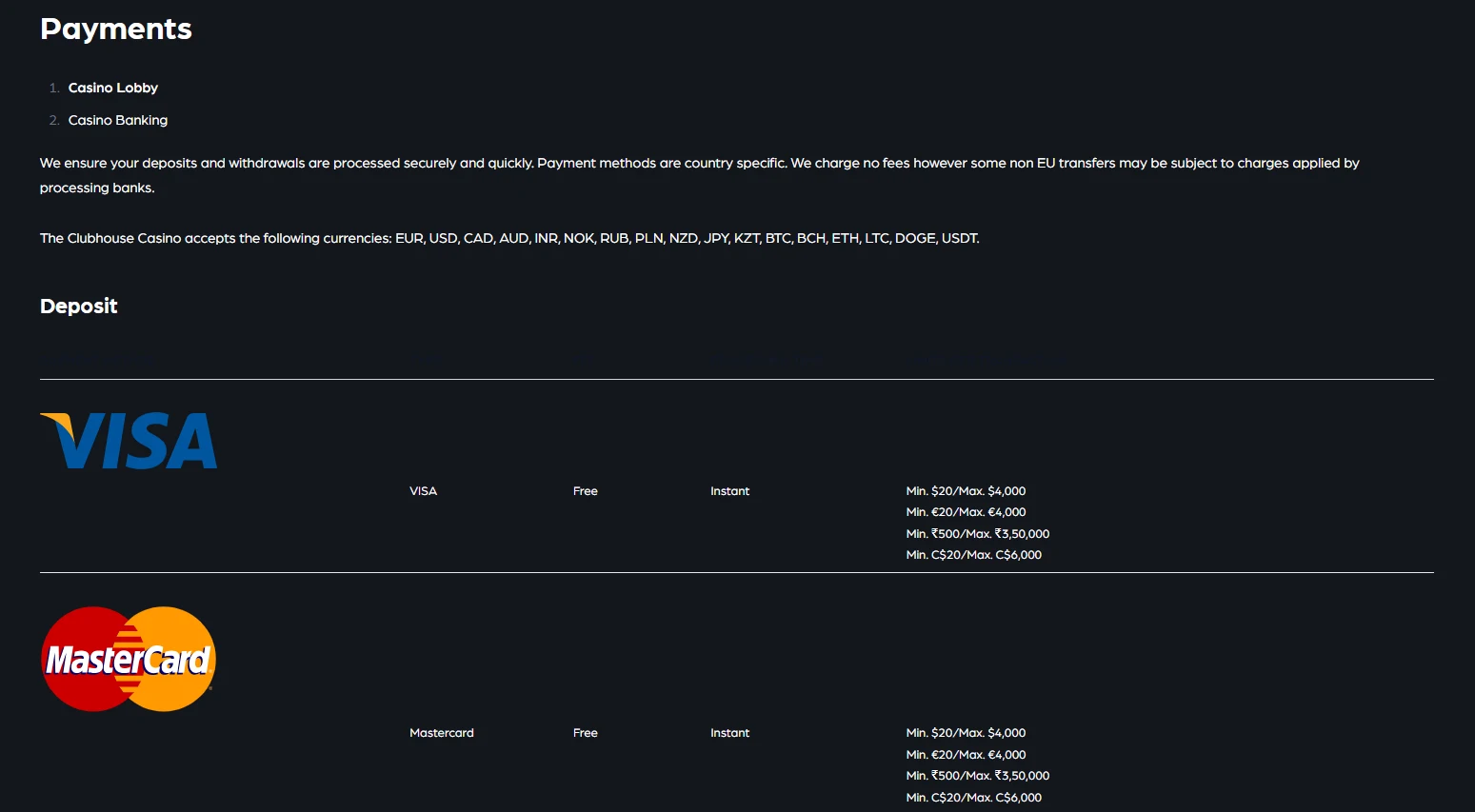
Visa-related wording can create a similar impression. A card logo on a deposit page does not, on its own, establish that card withdrawals are supported. Nor does a general claim about fast cashouts identify which payment route is available for a particular transaction. The useful distinction is functional, not promotional: which methods accept deposits, and which methods can receive withdrawals? Without that separation, “fast” tells little about the route actually available.

I have seen payment descriptions treated as if they were a single promise. They are not. One line can refer to deposits, another to withdrawals, and a third to processing after an operator has released funds. Blending those stages into one claim makes a cashier look simpler than it is. The interface may be tidy. The rules remain separate.
For anyone assessing the wording of a site, the withdrawal page and payment terms carry more weight than a deposit banner. The method needs to be named for withdrawals, not merely displayed somewhere in the cashier. If a voucher is listed only as a deposit option, it should not be assumed to provide a cashout route. That is the practical limit of the claim; it does not establish the timing or availability of any alternative.
There is also a legal context that cannot be separated from real-money slot services in Australia. The Interactive Gambling Act 2001 makes it illegal for operators to provide real-money online slots to people physically located in the country. Payment labels do not change that status. A deposit option is not evidence that a service is lawful to provide in Australia.
In short, deposit access and withdrawal access are different functions. A voucher may fund an account without serving as a cashout method. The logo alone proves very little.
Legal Prohibition
Under the Interactive Gambling Act 2001, providing real-money online casino games to people in Australia is prohibited.
Bank Transfers, Cards and E-Wallets: The Timing Gap
The difference between a bank transfer, a card payment and an e-wallet is not simply a matter of which logo appears in the cashier. Each route has its own handling time, and the estimate attached to a withdrawal may describe only one part of the journey. In the comparisons I have seen, e-wallets tend to have the shorter stated window; cards and traditional bank transfers can take longer.
A specialist review reports e-wallet withdrawals as typically processed within 24 hours, while card payments and bank transfers may take several days. That is a reference point, not a fixed service standard: the payment provider, the operator’s handling and the timing of the request can all affect the result. Another specialist review describes e-wallet transactions as completing within hours rather than days. Those accounts point in the same direction, but neither should be read as a guarantee for every transaction.
Bank transfers have a wider waiting window in the available reporting. One specialist review says a traditional transfer can take as long as five business days to complete. The phrase “business days” matters: a calendar gap that includes a weekend or public holiday may feel longer than the stated processing period. The figure is a reported upper limit, not a promise that every transfer will take that long.

Cards occupy an awkward middle ground. They are familiar and can be easy to use for payments, but that does not make a card refund or payout equivalent to an e-wallet transfer. The reported comparison puts card withdrawals in the several-days category, alongside bank transfers. A fast deposit therefore says little about how quickly money will return by the same route.
This is where the phrase “fast withdrawal” can mislead. It may refer to the operator’s handling, the payment method’s transfer time, or a combined estimate that does not explain which clock is being measured. An e-wallet route may have a shorter reported window, but it does not erase delays elsewhere in the process. Nor does a bank transfer necessarily mean a slow operator; the receiving route itself can take longer.
The practical comparison is straightforward: e-wallets have the more favourable reported timing, while cards and traditional bank transfers may require several days. The precise result still depends on the terms and route available for the transaction. A casino’s deposit options are not, by themselves, evidence that the same options are available for withdrawals.
I have seen timing claims lose meaning when they leave out the payment route. The method is part of the estimate. Read the stated window as a description of a particular route, not as a universal promise about when funds will arrive.
What “Best” Means When a Casino Promises Speed
UK casinos listed by payout speed
Withdrawal speed can depend on the payment method, so check the available payout details before choosing a casino. This list highlights the information provided for each operator without assuming unreported cash-out times.
Vegaz Casino
- License
- Curacao OGL/2024/1335/0780
- Min. deposit
- EUR 20
Vegaz Casino lists a Curacao OGL/2024/1335/0780 licence and a minimum deposit of EUR 20. No withdrawal-speed details are provided.
LevelUp Casino
- License
- Curacao eGaming OGL/2023/174/0082 (Dama N.V.)
- Min. deposit
- A$15
LevelUp Casino lists a Curacao eGaming licence, OGL/2023/174/0082, held by Dama N.V., and a minimum deposit of A$15. Its withdrawal speed is not specified.
WinSpirit Casino
- License
- Curacao eGaming OGL/2024/923/0383 (Antillephone N.V.)
- Min. deposit
- A$30
WinSpirit Casino lists a Curacao eGaming licence, OGL/2024/923/0383, held by Antillephone N.V., and a minimum deposit of A$30. No payout timing is provided.
MrPacho
- Payout speed
- crypto 30-120 minutes, fiat 24-72 hours
- Min. deposit
- A$30
MrPacho gives payout estimates by method: crypto withdrawals take 30–120 minutes, while fiat withdrawals take 24–72 hours. The minimum deposit is A$30.
Roby Casino
- License
- Curacao eGaming (Roby Games Ltd)
Roby Casino is listed with a Curacao eGaming licence held by Roby Games Ltd. No withdrawal-speed or deposit details are provided.
House of Pokies
- License
- international iGaming licence – jurisdiction not named in the source
- Payout speed
- PayID 1-24 hours
- Min. deposit
- A$30 (PayID from A$10)
House of Pokies lists an international iGaming licence, though the jurisdiction is not named. PayID payouts are stated as taking 1–24 hours; the minimum deposit is A$30, or A$10 for PayID.
Rollero Casino
- License
- Curacao Gaming Control Board OGL/2023/176/0095 (Hollycorn N.V.)
Rollero Casino lists a Curacao Gaming Control Board OGL/2023/176/0095 licence held by Hollycorn N.V. No withdrawal timing is provided.
Wild Tokyo
- License
- Curacao
- Payout speed
- crypto 30-60 minutes, fiat 1-5 days
- Min. deposit
- A$10
Wild Tokyo gives crypto withdrawal estimates of 30–60 minutes and fiat estimates of 1–5 days. Its minimum deposit is A$10.
SkyCrown
- License
- Tobique Gaming Commission
- Payout speed
- crypto ~10-15 minutes, fiat 1-5 days
- Min. deposit
- A$30
SkyCrown lists a Tobique Gaming Commission licence and estimates crypto withdrawals at around 10–15 minutes, with fiat withdrawals taking 1–5 days. The minimum deposit is A$30.
Bizzo Casino
- License
- Curacao Gaming Control Board (TechSolutions Group N.V.)
Bizzo Casino lists a Curacao Gaming Control Board licence held by TechSolutions Group N.V. No payout-speed or deposit details are provided.
“Best” is not a reliable description of a payout policy. It is a judgement that depends on what the operator actually accepts, what its terms permit and what happens between a withdrawal request and release of funds. A fast-sounding label cannot answer those questions on its own.
There is also a legal boundary that matters in Australia: the Interactive Gambling Act 2001 prohibits operators from providing real-money online casino games, including slots and table games, to people in the country. A discussion of payout claims is not an endorsement or recommendation of such services.
Payment availability is the first practical check. A payment method appearing beside a deposit button does not establish that it can receive withdrawals. The relevant information is whether the same method is available for cashouts, whether the account must be in the player’s name, and whether the operator’s rules require funds to return through the deposit route where possible. A list of logos is not a payment policy.

Then come the withdrawal terms. They should explain minimum and maximum amounts, any fees, and how limits apply to individual transactions as well as to a broader cashout period. A specialist review has described PayID operators as publishing minimum and maximum withdrawal limits clearly; that is a useful standard to look for in terms, not proof that every service does so. If a limit or fee is difficult to locate, the headline speed is only part of the offer.
The wording around timing deserves the same scrutiny. “Instant” can describe the payment leg after the operator approves a request; it does not mean a request is approved and received without delay. A specialist review reported cases where services promoted instant withdrawals but internal review extended the process to as long as 24 hours. That is a report about particular cases, not a dependable timetable for other operators. The important distinction is whether the terms separate review and release from the transfer itself.
I have seen speed claims do their best work in the gap between those stages. A page may foreground the point at which money moves while leaving approval conditions in smaller print. That does not make the claim meaningless, but it narrows what it can honestly promise. Read the timing language alongside the withdrawal rules, not as a substitute for them.

A useful assessment therefore looks for a complete policy: supported withdrawal methods, limits, fees, account requirements and a clear explanation of when the stated processing time begins. Those details make an offer assessable. “Best” remains a label. The terms do the explaining.
Verification and Bonus Terms Can Hold Up a Cashout
A payment method cannot resolve a withdrawal that has not been approved. In the Australian context, there is an important legal distinction: the Interactive Gambling Act 2001 prohibits operators from providing real-money online casino games, including slots and table games, to people in Australia. The checks described here are part of how withdrawal eligibility works; they are not an endorsement of using such services.
Identity checks can become the first hold on a payout. A specialist review reports that a first withdrawal may prompt a request to verify identity. That is a report about a possible operator process, not a fixed timetable. Where verification is required, the casino must complete its checks before processing a withdrawal. Until that approval is in place, a promise of an “instant” payment says little about when funds could be released.
Do
- Complete identity verification early to remove approval pauses
- Review bonus wagering terms to check fund eligibility
Don't
- Assume "instant" payment applies before account verification
- Expect immediate cashouts of funds subject to incomplete wagering
I have seen the practical difference between leaving verification until a withdrawal is requested and completing it earlier: early completion can make later withdrawals faster by removing a step that might otherwise pause approval. It does not guarantee a particular release time, and a casino may still need to review a later transaction. The useful distinction is between a payment that has been approved and one still waiting for an eligibility check.
Bonus wagering creates a separate hold. A specialist review describes two possible ways wagering conditions can be applied: to bonus funds alone, or to the deposit and bonus together. The first arrangement is preferable because it leaves the deposit outside the wagering condition. Either way, unfinished wagering can make funds ineligible for withdrawal until the stated requirement has been met.
A “no deposit bonus” is not necessarily a cashable balance. The label describes how the bonus is received, not whether it can be withdrawn immediately. Any wagering condition attached to it still matters, and the terms determine whether the bonus or other funds are restricted while that condition remains incomplete. The payment route is beside the point. Eligibility comes first.
In my experience, the wording that matters is often tucked into the bonus terms rather than the payment description. It should make clear which funds are subject to wagering and what must be completed before withdrawal. If those conditions are unclear, a headline about fast withdrawals cannot settle the question. Read the rule, not the label.
There are two different reasons a request may wait: identity approval and bonus eligibility. Neither is a transfer-network delay. A fast payment claim only becomes relevant after the casino has verified the account and the requested funds are available for withdrawal. Approval first. Payment second.
Bitcoin and Other Crypto Casino Withdrawals
A crypto payment can move quickly once it has been authorised and broadcast. That is the narrow point behind claims of near-instant cryptocurrency transactions: a specialist review may describe the transfer leg as almost immediate. It does not establish how long a withdrawal takes from the moment it is requested until funds reach a wallet. Those are different clocks.
The distinction matters because a casino withdrawal is not simply a blockchain transaction. There is first a request and an operator decision about whether it can be released. Only after approval can the payment be sent. The receiving wallet then has to register the transfer. A short final leg cannot erase time spent waiting for the first decision.
I have seen “instant” used as if it described the whole sequence. In practice, the word may refer only to the payment stage after approval. That is a much narrower promise. If a request is pending review, or the operator has not yet released it, the speed of the cryptocurrency network is beside the point. Fast transfer. Separate approval.
Bitcoin is often treated as shorthand for crypto payouts, but the label alone tells little about the withdrawal process. A site’s terms determine which assets it accepts, how a withdrawal is requested and what checks can delay release. The wallet destination also has to be supported by the service. A displayed crypto option is not, by itself, evidence that a withdrawal will be available on the same terms as a deposit.
This is where the wording around crypto can blur two separate questions: whether a payment route exists, and whether the whole cashout is quick. Some specialist reviews describe cryptocurrency as one of the payment options offered by certain casino services. That is not a general description of lawful real-money options in Australia. Under the Interactive Gambling Act 2001, operators cannot provide real-money online casino games, including slots and table games, to people physically located in Australia. The fast-payout language does not change that legal position.
Even when looking only at the payment mechanics, a quoted transfer speed needs context. It may describe a transaction after the operator has sent it, rather than the elapsed time from a withdrawal request. If a review or promotion reports a quick crypto transfer, the useful question is what event started the clock and what event stopped it. Without those boundaries, “fast” can mean a brief network transfer wrapped in a longer approval process.
Crypto also changes the destination side of the transaction. A bank transfer lands in a bank account; a crypto withdrawal is directed to a wallet. The operator’s instructions and the receiving service’s requirements therefore matter. A mismatch in destination details, an unsupported asset or an incomplete request can prevent a smooth payment. These are not speed advantages or disadvantages of Bitcoin itself; they are conditions around using the route.
I would read a speed claim as a statement about one stage unless it clearly explains the full path. The operator may receive the request, review it, approve it, send the transaction and provide a status update at different points. A timer that begins only when the transaction is sent excludes the time before approval. A claim that does not say when timing begins is difficult to compare with another claim.
There is also a difference between a payment being sent and the recipient seeing usable funds. A transaction may be visible before the receiving service treats it as complete. So “sent” is not necessarily the same as “available”. This is why a claim about a near-instant crypto transfer should not be read as a guarantee of immediate access from the initial request.
For Australian readers, that distinction sits beneath a more fundamental issue: real-money online casino services are prohibited when offered to people in the country. Crypto does not create an exception, and a rapid transfer does not make the underlying service lawful. The mechanics can explain what an advertised payout phrase means; they do not turn an offshore casino offer into a permitted one.
The practical reading is simple: separate request, approval and transfer. A cryptocurrency network may handle the last part quickly, as specialist commentary has reported, but the total time depends on the steps that come before it too. “Instant” is a phase, not a full timeline.
What a “Top” Fast-Payout Claim Actually Shows
A “top” label can make a payout figure look like a stable property of a casino. It is better read as the result of a particular test: a reviewer observed a withdrawal under particular conditions, then reported the elapsed time. That is evidence about one transaction or a set of transactions, not a promise that every request will follow the same path.
E-Wallets
Typically processed within 24 hours, with some transactions completing within hours.
Card Payments
Usually fall into the several-days category for withdrawals.
Bank Transfers
Can take several days, with some reported upper limits of up to five business days.
A specialist review of Australian PayID options reported average withdrawal times ranging from 30 to 90 seconds. Another specialist review recorded averages of 47 seconds and 68 seconds for two operators, while a third took 3.2 minutes, with first-withdrawal security checks noted as the reason. Those figures are useful as observations, but they do not establish a market-wide benchmark. The result can change with the account, the request and whether the operator applies a review.
The distinction matters because “instant” is often doing more work in the headline than in the payment process. A specialist review reported sites advertising instant withdrawals that took as long as 24 hours when internal checks intervened. The transfer itself may be quick once released; the operator’s decision to release it is a separate event. A clock that starts only after approval leaves that earlier waiting time out of view.
I have found that the useful question is not simply how small the quoted number is. It is what the measurement actually includes. Does timing begin when the withdrawal is submitted, or only when it has cleared internal handling? Does the report describe a first withdrawal or a later one? Were exceptions and review delays counted, or described separately? Without those details, a precise figure can still give an incomplete picture.
Nor does a ranking settle whether a real-money casino service is lawful for Australians. The Interactive Gambling Act 2001 prohibits operators from providing online casino games to people in Australia. A payout claim is not an endorsement or a change to that legal position.
A measured time can help illustrate what happened in a test. It cannot guarantee the next result, and it should not be mistaken for the full time from request to receipt. The headline is the short version. The conditions are the story.
PayID Withdrawals: Instant Transfer, Not Instant Approval
PayID is part of Australia’s bank-to-bank payment infrastructure. It operates through the New Payments Platform (NPP), with transfers processed in real time through the Osko network. That describes the movement of money between accounts—not the time taken for a gambling operator to approve a withdrawal.
The distinction is easy to lose in the word “instant”. A transfer can move quickly once released, while a withdrawal request may still be waiting in an operator’s system. The casino has to approve the request before the payment network becomes relevant. A fast transfer therefore does not establish that funds will arrive instantly from the moment a request is submitted.
I have seen promotional language collapse those two stages into one. That is convenient wording, but it leaves out the operator’s decision point. A specialist review has reported PayID withdrawals taking under five minutes at some Australian-focused casinos, against one to three business days for standard bank transfers. Those are reported results, not a guaranteed timetable for every request or operator.
Where PayID is offered, the withdrawal process may ask for the PayID identifier, amount and confirmation. The account details should match those linked to the casino profile; using different PayID details from a deposit can trigger a security review. Any delay before approval remains separate from Osko’s real-time transfer function.
PayID also does not change the legal position of the service using it. Under Australia’s Interactive Gambling Act 2001, providing real-money online casino games, including slots and table games, to people in Australia is illegal for operators. A payment method is not evidence that a gambling service is lawful or approved.
The practical reading is narrow: PayID can describe the payment route and its transfer capability, not a promise that a withdrawal request will be approved immediately. “Instant” starts after release. Before that, the operator controls the clock.
How do you choose the best easy withdrawal casino site?
Compare the full cashout timeline, including how long approval takes and when the payment provider starts its transfer. Check that withdrawal limits are clearly published, verify your identity early, and review any fees or bonus wagering conditions.
How fast are withdrawals?
E-wallet withdrawals are often completed within hours and typically processed within 24 hours, while bank transfers can take up to five business days. PayID transfers can arrive almost instantly after the casino releases the funds, but internal reviews and first-time identity checks can add delays.
What are easy withdrawal casinos?
They are casinos whose cashout process involves straightforward approval and payment steps, with clear withdrawal limits and payment options that can deliver funds quickly. A fast payment method alone does not guarantee a quick payout if the operator has not yet approved or released the withdrawal.
What payment methods are available?
Options may include bank transfers, credit or debit cards, PayPal, Skrill and, at some services, cryptocurrency. Some Australian-facing services also offer instant banking through providers such as POLi; prepaid vouchers such as Neosurf are generally for deposits rather than withdrawals.
Written by the editors at Clubhouse Casino.