

Understand the Money Side Before You Play
Bitcoin is a payment method, not a different kind of game; account rules shape how deposits, play and withdrawals work.

Table of Contents
What Bitcoin-Paid Pokies Actually Involve
Bitcoin pokies are digital slot machines that accept Bitcoin as a payment method. The label describes the payment option, not a different kind of game: the play still centres on a machine’s symbols, rounds and game-specific credits. Bitcoin is part of the money side of the arrangement; it does not make credits interchangeable between games or turn the game itself into a Bitcoin wallet.
There are two distinct ways to encounter this format: free play and real-money play. Free play uses credits supplied for practice or demonstration. Those credits are not a Bitcoin balance and do not represent money that can be withdrawn. A screen may show a balance, a stake and a result, but those numbers belong to the game’s play mode. A displayed win in free play is not a Bitcoin payment.
Real-money play is different because Bitcoin is used as value at risk. A player’s Bitcoin is converted, credited or otherwise represented within the operator’s account system for use in the game. Any resulting balance is then subject to the operator’s rules and the way the account handles deposits, play and withdrawals. The game interface can look much the same in both modes. The distinction is not always obvious from the reels or buttons; it lies in whether the credits are merely for practice or are connected to funds.
UK casinos listed by payout speed
For Australian players looking at bitcoin pokies in 2026, this list offers a concise reference to operator details that may help inform further checks. Review the available licensing and payment information before deciding where to play.
Vegaz Casino
- License
- Curacao OGL/2024/1335/0780
- Min. deposit
- EUR 20
Vegaz Casino lists a Curacao OGL licence (OGL/2024/1335/0780). Its minimum deposit is EUR 20.
LevelUp Casino
- License
- Curacao eGaming OGL/2023/174/0082 (Dama N.V.)
- Min. deposit
- A$15
LevelUp Casino lists a Curacao eGaming licence, OGL/2023/174/0082, associated with Dama N.V. The minimum deposit is A$15.
WinSpirit Casino
- License
- Curacao eGaming OGL/2024/923/0383 (Antillephone N.V.)
- Min. deposit
- A$30
WinSpirit Casino lists a Curacao eGaming licence, OGL/2024/923/0383, associated with Antillephone N.V. Its minimum deposit is A$30.
MrPacho
- Payout speed
- crypto 30-120 minutes, fiat 24-72 hours
- Min. deposit
- A$30
MrPacho lists crypto payout times of 30–120 minutes and fiat payout times of 24–72 hours. The minimum deposit is A$30.
Roby Casino
- License
- Curacao eGaming (Roby Games Ltd)
Roby Casino lists a Curacao eGaming licence held by Roby Games Ltd. That licensing detail is the available point of reference here.
House of Pokies
- License
- international iGaming licence – jurisdiction not named in the source
- Payout speed
- PayID 1-24 hours
- Min. deposit
- A$30 (PayID from A$10)
House of Pokies lists an international iGaming licence, though the source does not name its jurisdiction. PayID payouts are listed at 1–24 hours; the minimum deposit is A$30, or A$10 for PayID.
Rollero Casino
- License
- Curacao Gaming Control Board OGL/2023/176/0095 (Hollycorn N.V.)
Rollero Casino lists a Curacao Gaming Control Board licence, OGL/2023/176/0095, associated with Hollycorn N.V. The licensing information is its available distinguishing detail.
Wild Tokyo
- License
- Curacao
- Payout speed
- crypto 30-60 minutes, fiat 1-5 days
- Min. deposit
- A$10
Wild Tokyo lists a Curacao licence and a minimum deposit of A$10. Its stated payout times are 30–60 minutes for crypto and 1–5 days for fiat.
SkyCrown
- License
- Tobique Gaming Commission
- Payout speed
- crypto ~10-15 minutes, fiat 1-5 days
- Min. deposit
- A$30
SkyCrown lists a Tobique Gaming Commission licence and a minimum deposit of A$30. Crypto payouts are listed at approximately 10–15 minutes, while fiat payouts are listed at 1–5 days.
Bizzo Casino
- License
- Curacao Gaming Control Board (TechSolutions Group N.V.)
Bizzo Casino lists a Curacao Gaming Control Board licence held by TechSolutions Group N.V. The available information here is limited to that licensing detail.
That difference matters when promotional language calls a game “free.” The word can refer to a demo mode, while other uses may refer to a bonus or a real-money account feature. Those are not the same thing. In free play, the credits have no cash-out value. In real-money play, the balance is tied to funds and conditions set by the operator. The label on a button is not enough to establish which mode is active; the account and game terms determine that.
Game credits are specific to each game. A credit unit shown in one title should not be assumed to have the same Bitcoin value in another. A specialist review has described the relationship as depending on both the game’s credit system and the current Bitcoin price. That is a useful distinction, rather than a stable conversion rule: the game defines its units, while Bitcoin’s market price changes. The amount represented by a credit therefore cannot be read from its label alone.
This also explains why a balance displayed as credits is not necessarily a direct Bitcoin amount. The game may show its own unit, while the account or payment interface handles Bitcoin separately. A player comparing two games may see similar-looking credit totals that represent different values. Conversely, the same Bitcoin amount can correspond to different credit counts depending on the game’s denomination. Reading the figure as if every credit were a fixed fraction of a Bitcoin can lead to a mistaken impression of the stake.

The practical distinction is between the game’s accounting and the payment asset. Bitcoin is the payment asset; credits are the game’s unit of play. The interface connects them, but they are not identical. Any conversion displayed by a site is specific to its own setup and the current BTC price, and should not be treated as a universal property of Bitcoin pokies.
The term can also obscure the fact that these are still gambling products when played for money. Bitcoin changes the payment method, not the underlying activity or the possibility of losing funds. Free play removes the cash stake, but it does not transform a demonstration into a real-money session. For real-money gambling, participation is restricted to adults aged eighteen or older.
In Australia, this explanation is descriptive, not an invitation to use an offshore casino. The payment label does not change the status of the product or make a prohibited service lawful. The next distinction to keep in mind is therefore not between one Bitcoin game and another, but between a demonstration with non-cash credits and play connected to money. Affiliate material notice: this page may include sponsored links.
The Australian Context: Offshore Operators and Legal Limits
The legal dividing line is not whether a casino accepts Bitcoin. It is whether an operator provides real-money online casino games to people in Australia. Under the Interactive Gambling Act 2001, providing online casino-style games—including pokies—to customers physically located in Australia is prohibited. A Bitcoin payment method does not create an exception.
Legal Prohibition
Under the Interactive Gambling Act 2001, providing real-money online casino-style games, including pokies, to people in Australia is prohibited regardless of the payment method used.
That distinction can be obscured by the phrase “Australian casino”. It may describe a site’s intended audience or the currency and language it presents, rather than a business licensed to provide real-money casino games under Australian law. There is no locally licensed online casino route for residents to play real-money pokies: Australian law prohibits locally licensed online casinos from offering them. The rules concern the service being supplied, not simply the wording on a site or the asset used to fund an account.
The offshore operators discussed in this market hold licences primarily from Curacao eGaming or the Anjouan Gaming Authority. Those are offshore licensing jurisdictions, not Australian authorisations. A foreign licence may indicate that an operator is subject to a licensing framework elsewhere, but it does not make the service locally licensed or override Australia’s prohibition on providing these games to people in Australia.
That difference matters because licensing language can sound more protective than it is. A licence issued abroad does not bring an offshore operator within Australia’s local casino framework. Nor does the presence of a familiar payment method, local-facing wording or a claim of international oversight alter the operator’s position under Australian law. The legal status follows the service and the location of the customer, not the branding.
The Interactive Gambling Act also sets out substantial penalties for operators that breach it. The maximum daily penalty is $360,000 for an individual and $1.8 million for a body corporate. These are penalties for individuals or companies violating the Act; they are not a statement that a player faces those fines merely for playing. The distinction between the provider’s legal obligations and a player’s position should not be blurred.

For the player, the more immediate practical gap is consumer protection. Australian consumer protection laws do not apply to the offshore operators discussed. A dispute with such an operator therefore does not have the same local framework behind it as a dispute with a business governed by Australian consumer law. An overseas licence is not a substitute for Australian consumer protections, and a support team’s presence or a polished website does not change that boundary.
This is where the payment method and the legal context must be kept separate. Bitcoin describes how value is transferred; it does not determine whether an online casino service is lawful to provide in Australia. It also does not supply the protections that are absent when an operator is offshore. The mechanics of a cryptocurrency payment may be considered independently, but they cannot resolve the legal or consumer-protection questions around the underlying gambling service.
Real-money gambling is for adults aged eighteen or older. That age threshold is a minimum, not an indication that the service is locally authorised. Meeting an age requirement does not change the prohibition on operators providing real-money online casino games to people in Australia, and an offshore licence does not change it either.
The words “licensed” and “regulated” can therefore conceal an important qualifier: licensed where, and under which rules? In this context, the licences are offshore. They should not be read as evidence of Australian approval or as a guarantee that Australian remedies apply. The distinction is substantive, not cosmetic.
This page is affiliate material and may include sponsored links. That commercial disclosure does not alter the legal position described above or turn an offshore licence into an Australian one. The core point remains the same: Bitcoin is a payment method, while the legality of providing real-money pokies to people in Australia is governed by Australian law. Payment rails do not redraw that boundary.
How to Assess Claims About Bitcoin-Pokies Sites
Claims about Bitcoin pokies sites are easier to assess when they are separated into three things: what reviewers say, what a licence actually establishes, and what the game catalogue contains. None of those points, on its own, establishes that a site is suitable or that a claim about it is dependable.
A specialist review advises looking at reviews, licensing and the range of pokies. That is a starting checklist, not a verdict. The useful question is what evidence sits behind each item. A page can call reviews “good” without explaining how they were gathered, whether they describe real experiences or whether complaints and favourable comments are treated consistently. A broad claim is not evidence merely because it appears in a polished comparison.
Read reviews as evidence, not a score
The word “trusted” is often doing more work than the material beneath it. A review may give a rating but say little about how it reached that number. A more informative account explains what was checked and distinguishes observation from promotional wording. It should make clear whether the reviewer is describing the site’s stated terms, reporting a direct test or repeating information supplied by the operator.

I look for specificity and balance. Does the review explain the basis for its assessment? Does it mention conditions that could affect a player’s experience, or only repeat claims about convenience and choice? Does it separate a site’s own promises from the reviewer’s findings? If every point is positive and none can be traced to a stated basis, the score is a weak signal.
Complaints need the same care. A negative account may describe a genuine problem, but a single report does not establish that every similar case will end the same way. Several accounts may also repeat the same original claim rather than provide independent evidence. The sensible reading is neither to dismiss criticism nor to treat repetition as proof. Look at what is actually described, and whether the account gives enough detail to understand the issue.
“Independent” is another label, not a guarantee. The page may contain affiliate material and sponsored links; this article is affiliate material and may include sponsored links. That disclosure is relevant to how recommendations are presented, but it does not turn a recommendation into neutral evidence. The question remains whether the reasoning is visible and whether the commercial relationship is made clear.
What a licence can—and cannot—tell you
Licensing claims should be read precisely. A statement that an operator holds an offshore licence identifies a claimed regulator; it does not establish that the operator is locally authorised to provide real-money pokies in Australia, or that Australian consumer protection laws apply to it. For the offshore operators discussed in this market, licences are primarily associated with Curacao eGaming or Anjouan Gaming Authority. Naming a regulator is not the same as demonstrating the scope or current status of a particular licence.
A careful assessment distinguishes a licence claim from a general assurance such as “fully safe” or “regulated everywhere”. The latter phrases can imply more than the licence establishes. A comparison page that treats an offshore licence as a substitute for Australian protections has blurred two separate matters. That is not a small wording issue. It changes what a reader may reasonably infer.
Nor should a licence badge be treated as a complete assessment of how a site handles every customer issue. It is one piece of information about the operator’s stated oversight. It does not, by itself, settle the accuracy of other claims on the page, the quality of the available games or the practical outcome of a dispute. Read the wording around the badge, not just the badge.
Game selection is not a quality measure
A diverse selection of pokies can be a useful description of a catalogue, but catalogue size is not a measure of fairness, reliability or overall quality. A long menu tells little about how clearly a site explains its terms or whether its other claims are well supported. A review should say what it means by “wide choice” rather than using the phrase as a substitute for assessment.
The same applies to labels such as “top-rated” or “best”. Without a stated basis, those words describe the reviewer’s conclusion but do not show how it was reached. If the page does not explain its criteria, the reader cannot tell whether the ranking reflects game choice, the reviewer’s preferences or commercial placement. A neat table can make an opinion look like a measurement. It is still an opinion unless its method is shown.

I also separate catalogue information from claims about player outcomes. A description of game variety does not establish anything about likely returns or a particular person’s experience. When a page moves from describing choice to implying an advantage, the extra claim needs its own evidence. One claim cannot quietly carry another.
A practical reading standard
The most useful comparison is not a single overall score. It is whether each claim has a clear basis, whether the wording stays within that basis, and whether commercial interests are disclosed. Reviews can inform an assessment; licensing claims can identify the claimed oversight; catalogue descriptions can indicate breadth. Each has limits.
In my experience, the telling detail is often what a page fails to distinguish: operator wording presented as independent review, an offshore licence presented as local protection, or a large catalogue presented as proof of quality. Those are different claims. Keep them separate, and the promotional language becomes easier to recognise.
Moving Bitcoin In and Out: The Transaction Steps
This is a description of how a Bitcoin payment route is presented, not an invitation to use it. In Australia, real-money online casino games are prohibited, and offshore operators are not covered by Australian consumer protection laws. This page is affiliate material and may include sponsored links.
Bitcoin Deposit Process
- 1
Acquire Bitcoin
Purchase Bitcoin through a cryptocurrency exchange using fiat currency and hold it in a wallet.
- 2
Obtain Address
Copy the specific Bitcoin address supplied by the casino account interface for the payment.
- 3
Initiate Transfer
Enter the copied address as the destination in your wallet and send the Bitcoin.
The payment path starts outside the casino account. Bitcoin can be acquired through a cryptocurrency exchange using fiat currency, then held in a wallet from which a transfer can be made. The exchange and wallet are distinct parts of the process: buying Bitcoin does not itself credit a casino account. A transfer still has to be initiated from the wallet.
For a deposit, the account interface supplies a Bitcoin address for the payment. The sender copies that address and enters it as the destination in the wallet, then sends Bitcoin from the wallet. The address is the critical routing detail: the transfer goes to the destination entered, not to an account name or a username. That makes checking the copied address part of the payment itself, rather than a clerical step to leave until later.
A casino account may display a payment status separately from the wallet’s record of a sent transaction. Those are not the same thing. The wallet records the transaction submission; the operator’s account interface reflects whether the payment has been detected and credited. A gap between the two can therefore arise at the operator’s end, even when the sender can see the transfer in the wallet. The operational distinction matters: a payment showing as sent is not necessarily displayed as available account balance.
The transfer also has a network cost. Bitcoin transactions incur a miner’s fee, and the fee varies over time. A specialist review describes that charge as typically small, but it should not be treated as a fixed amount or as a promise of a particular total cost. The displayed fee and the amount being sent are separate figures; the wallet’s confirmation screen is where they can be inspected before a transfer is authorised. I would treat any broad claim that Bitcoin is “free” as advertising language. The network fee remains part of the transaction.

A withdrawal reverses the direction of the payment but uses a different form. The player copies a personal wallet address and pastes it into the casino’s withdrawal form, then submits the request. The destination should be a wallet the player controls and can access. A withdrawal request in the casino interface is not the same event as a completed blockchain transfer: the operator must process the request and send the Bitcoin before the wallet can receive it.
A specialist review reports that most Bitcoin withdrawals are completed within an hour. That is a claim about the transactions it reviewed, not a dependable service standard for every operator or every request. The clock may not begin when the withdrawal form is submitted; an operator can have an internal approval step before sending anything to the blockchain. That distinction keeps payment-network timing separate from the operator’s own handling time.
In practical terms, there are two stages to watch: the operator’s processing of the request and the subsequent transfer to the nominated wallet. A statement about the speed of one stage does not establish the speed of the other. The network fee applies to a Bitcoin transfer, while an approval queue is an operator-side matter. Mixing those explanations makes a delay difficult to diagnose.
The address fields deserve more attention than the promotional labels around them. A deposit uses the address supplied for that payment by the casino interface; a withdrawal uses the address copied from the receiving wallet. They serve opposite directions and should not be swapped. The blockchain cannot infer that an address was mistyped or pasted into the wrong field. Bitcoin transfers to incorrect addresses are generally unrecoverable because blockchain transactions are irreversible.
Do
- Verify the copied address before confirming the transfer
- Keep wallet transaction records and account status separate
- Use stated support channels to report discrepancies
Don't
- Swap deposit and withdrawal address fields
- Send additional payments to "unlock" a missing deposit
- Share wallet recovery phrases or private keys
I learned to read payment screens as records of separate events, not as a single “instant” service. The wallet, blockchain and operator account each show a different part of the trail. A timestamp or status in one place does not settle what has happened in the others. Keep the wallet transaction details and the account’s payment status distinct; that is the cleanest way to understand the route without mistaking a request for a completed transfer.
When a Deposit or Withdrawal Goes Wrong
A payment problem does not always mean the Bitcoin has disappeared. It can mean the blockchain transfer completed but the casino account has not been credited, or that the operator has paused a withdrawal for its own review. Those are different failures, and treating them as one can lead to poor decisions.
A deposit that does not appear
A deposit may be missing from the account even after Bitcoin has been sent. One cause is address reuse: an address may not be treated as a fresh deposit destination for a later payment, depending on how the operator’s payment system handles it. Another is underpayment, where the amount received does not meet the operator’s stated deposit requirement. Detection can also be delayed on the operator’s side.
The important distinction is between the transfer record and the account balance. A transfer may be visible on the blockchain while the casino account still shows no credit. That does not, by itself, establish whether the delay is routine processing, a mismatch in the deposit details or an operator error.

From the operations side, a payment desk often sees only what its system has matched to an account. If a transfer is not matched automatically, the case may need to be checked manually. That is not the same as the funds being recoverable or the account being credited automatically. Keep records of the transaction and any account messages, and use the operator’s stated support channel to report a discrepancy. Do not send another payment simply to make the first one “show up.”
When an address is wrong
Bitcoin and Ethereum transactions sent to an incorrect address are generally unrecoverable. A blockchain transfer is not a card payment that can simply be reversed through the payment network. Once it has been recorded to the wrong destination, the casino may have no ability to retrieve it. The same warning applies if a transfer is sent to an address that belongs to someone else.
This is why a payment dispute can turn on a detail that looks small: the destination address. A transaction record can show where funds went, but it does not prove that the intended recipient controls that address or can return the funds. If an operator says it has not received a deposit, compare the transaction destination with the details associated with the payment, rather than assuming that a completed transfer must have reached the correct account.
There is no reliable “undo” button. Claims that a further payment will reverse a mistaken transfer deserve particular scepticism. A second transfer is another transaction, not a recovery mechanism.
Irreversible Transactions
Blockchain transfers to incorrect addresses are generally unrecoverable, and any claim that a further payment can reverse a mistaken transfer should be treated with extreme scepticism.
A withdrawal placed under review
A withdrawal can also stop after a significant win. Some operators may subject a payout to a security review; in practice, that review can become a stalling tactic, particularly for a new account or a first large withdrawal. The existence of a review does not prove misconduct, but neither does the word “security” explain what is happening.
I have seen a useful distinction in how these cases are handled: a genuine review has a stated reason and a clear request for information, while a vague status that keeps changing gives little to assess. The payment itself may not be moving at all while the account is being reviewed. That is an operator-side hold, not a blockchain confirmation delay.
Keep the withdrawal request, status messages and relevant correspondence together. Ask for the reason the payout is paused and what specific issue remains unresolved. Avoid making claims about a transaction that cannot be supported by its record. A clear timeline of events is more useful than repeated, emotional messages.
Most importantly, do not deposit more money to unlock a stuck withdrawal. A demand for an extra payment before an existing payout can be released is a serious warning sign, not a normal way to repair a pending transfer. Sending more does not make the original withdrawal valid or force the operator to approve it.

Keep the categories separate
A missing deposit, a mistaken address and a reviewed withdrawal call for different explanations. Deposit non-recognition can involve address reuse, an underpayment or late detection by the operator. A wrong-address transfer raises the separate problem of blockchain irreversibility. A withdrawal hold may be an operator decision, including a review after a win. Confusing these categories makes it easier for a support response to go unanswered or for a player to take an unnecessary financial risk.
For people in Australia, this information is not an endorsement of offshore gambling. Real-money gambling is restricted to adults aged eighteen or older, and Australian consumer protection laws do not apply to the offshore operators discussed. This is affiliate material and may include sponsored links; that disclosure does not make an operator locally protected or a payment dispute safer. The practical limit remains stark: blockchain transfers generally cannot be recalled, and additional deposits should never be treated as a key to a withdrawal.
Verification Delays and Bonus Disputes
A withdrawal can be held up even after the payment request has been submitted correctly. The delay may sit with the operator rather than the Bitcoin network: staff approval queues, missing identity checks and batch processing during business hours can all leave a request pending. A displayed status such as “processing” does not, by itself, show which stage is holding it.
The distinction matters. A wallet transfer and an operator’s decision to release funds are separate events. Once a withdrawal request enters an approval queue, the operator may still be checking account details, reviewing documents or waiting for its next processing batch. A fast-looking payment method cannot remove those steps. The queue is still there.
Common Verification Triggers
Some operators request identity documents only at the first withdrawal, while others trigger stage-two verification when cumulative deposits reach thresholds typically between AUD 2,000 and AUD 5,000.
When identity checks arrive
Some operators ask for additional identity and address documents only when an account reaches its first withdrawal. Others may start stage-two verification after cumulative deposits reach a threshold somewhere between AUD 2,000 and AUD 5,000; the trigger depends on the operator. That means an account can appear usable for a period and then encounter a document request when money is due to leave.
This timing is not necessarily evidence of a problem with the payment itself. It does, however, mean that a withdrawal request can expose checks that were not completed earlier. A specialist review has recommended completing later verification stages before the first withdrawal, ideally within 24 hours of registration, as a way to reduce a common source of delay. That is a recommendation reported by that type of source, not a guarantee that an operator will approve a request promptly.
The practical distinction is between submitting documents and having them accepted. An incomplete file, unclear image or mismatch in account information may send a case back for further review. Even where the documents are complete, a request still has to pass through the operator’s process. From the counter side, “under review” is a broad label; it can cover several different tasks, and it does not tell the account holder which one remains outstanding.
Crypto can add a separate ownership check. A specialist review describes possible requests to sign a message using the deposit address or to provide a wallet screenshot showing the outgoing transaction. These are ways an operator may try to connect the account with the wallet used to fund it. They are not universal requirements, and a screenshot should not be treated as proof that every requested detail is safe to disclose. Verification requests should be assessed carefully, especially if they ask for wallet recovery phrases or private keys. Those credentials give control of a wallet; they are not needed to demonstrate a transaction.

How bonus calculations turn into disputes
Bonus terms can make a balance look available while restricting how it can be used or withdrawn. One point that often gets missed is the contribution rate: different games can count differently toward wagering requirements. The stated structure in these terms may give table games a 0% contribution and pokies a 100% contribution, while some high-RTP slots may be capped at 50%.
The result is that a session’s contribution to a bonus condition may not match the amount wagered. A player may see activity in the account but find that it has made little or no progress under the operator’s calculation. If the terms do not make the game categories or rates easy to locate, that gap becomes a dispute about interpretation as well as arithmetic. “Flexible” terms can mean the operator has discretion over which play counts.
Maximum-bet conditions create another route to a bonus being voided. If the operator says a maximum stake was exceeded during bonus play, it may remove the bonus or related winnings under its rules. The disagreement often turns on what counts as a breach: whether the limit applied to each spin or wager, when bonus conditions were active, and which balance was being used. The account history and the exact terms in force at the time are more useful than a general statement that the play was “valid.”
In a dispute, keep the relevant terms, account messages and transaction records together, and compare the operator’s explanation with the specific clause it relies on. A generic response that a bonus was “abused” does not explain which contribution rule or maximum-bet condition was applied. Nor does a displayed bonus balance necessarily mean the funds are withdrawable.
“Best” claims do not resolve any of this. A site description or ranking cannot establish how a particular operator will interpret its terms or handle a verification queue. This material is affiliate content and may include sponsored links; that commercial context should not be mistaken for independent assurance. Australian consumer protection laws do not apply to the offshore operators discussed. Real-money gambling is restricted to adults aged 18 or older.
Can Australians use Bitcoin at online casinos for entertainment?
Yes, Australians can use free-play pokies for entertainment, but those credits have no cash-out value. Real-money online casino games are prohibited from being provided to people in Australia, and paying with Bitcoin does not change that.
What is in the game library?
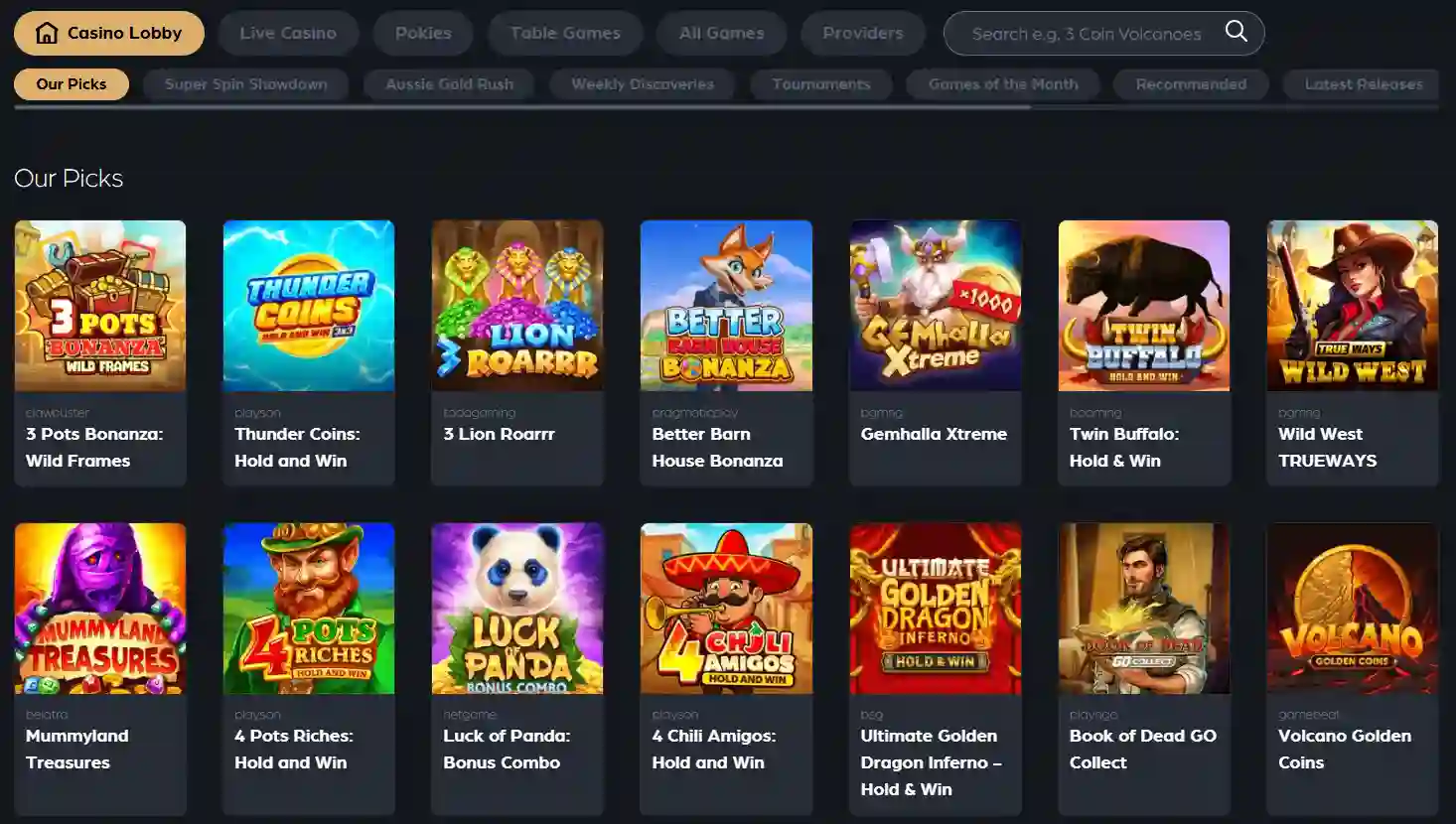
The library includes online pokies, with a diverse selection of titles. Game credits and their Bitcoin value are specific to each game.
Is verification required?
Verification may be requested at the first withdrawal or when cumulative deposits reach AUD 2,000–5,000, depending on the operator. Crypto checks may include signing a message from the deposit address or showing the wallet transaction.
Written by the editors at Clubhouse Casino.