


Check Which Payment Route You’re Using
The guide distinguishes PayID on the NPP from conventional bank transfers and explains how the routes relate to casino deposits and withdrawals.

Table of Contents
Table of Contents
- Bank Transfers on Online Pokies: What the Payment Route Actually Covers
- Making a Casino Deposit from a Banking App
- Checking Whether a Bank-Transfer Casino Is Usable
- Instant PayID Versus a Traditional Bank Wire
- Bank-Transfer Withdrawals: Details, Limits and the Return Route
- Where Fast PayID Payouts Still Get Held Up
- Paying by Bank Transfer Without Letting a Bonus Set the Terms
- Direct Bank Transfers, Real-Money Movement and the Costs Around Them
- What “Top” Means When No Operator List Is Being Promised
Bank Transfers on Online Pokies: What the Payment Route Actually Covers
“Bank transfer” sounds like one payment method. In practice, the phrase can describe different ways of moving money through banking services, and PayID is one of them. It is not simply another name for a conventional bank wire. PayID operates through Australia’s New Payments Platform (NPP), using an identifier such as a mobile number or email address to send or receive a payment.
That distinction matters when payment language appears alongside online pokies. A reference to bank transfers may mean a bank-linked service such as PayID, or it may mean a traditional transfer that uses the recipient’s banking details. The label alone does not identify the underlying route. I have found that payment copy often compresses those differences into a single phrase, which makes it sound as if every option works in the same way. It does not.
What PayID means in this context
PayID is a payment service, while the NPP is the infrastructure through which it operates. The identifier gives a payment destination a form other than a string of bank-account details. A mobile number or email address can be used to send or receive money through the service. The bank remains part of the arrangement; PayID is not a standalone wallet that replaces the banking relationship.
That is why “PayID casino” and “bank-transfer casino” can overlap in payment descriptions without being exact synonyms. PayID is bank-linked, but its identifier-based approach differs from a conventional wire. When an operator uses broad wording such as “bank transfer,” the important question is what the named method actually refers to, not whether the phrase sounds familiar.
The words can also create an impression of a routine local banking service being offered for a lawful gambling product. In Australia, that impression needs qualification. The Interactive Gambling Act 2001 prohibits operators from providing real-money online casino games to people physically located in the country. That includes pokies and other casino-style games, as well as poker and table games. The prohibition concerns the operator’s provision of the service; it does not turn a payment label into evidence that the underlying activity is permitted.


The payment route is not the gambling service
A bank-linked payment method and the activity receiving the payment are separate parts of the transaction. PayID describes a way to move money through the NPP. It does not establish that a particular online casino service may lawfully be offered in Australia, nor does the existence of a payment option change the legal status of the product.
This separation is easy to miss in commercial descriptions. A page may place “PayID,” “bank transfer” and “pokies” close together, making the arrangement appear like an ordinary payment choice for an Australian entertainment service. The payment infrastructure can be real while the advertised gambling service remains prohibited for operators to provide to people in Australia. Two different questions. Two different answers.
I have seen payment language do too much work in a sentence. “Accepts bank transfer” may describe a payment facility, but it says nothing by itself about the operator’s legal position, the destination of funds or the nature of the service. It is a description of a route, not a regulatory endorsement.

Why the terminology gets muddled
The phrase “online pokies bank transfer” is often used as a broad category rather than a precise technical description. It may refer to PayID, a conventional bank wire, or another bank-connected arrangement. These are not interchangeable merely because money ultimately moves through a bank account.
PayID has a defined role: it lets people send and receive payments using an identifier through the NPP. A traditional bank wire, by contrast, is a separate form of transfer. Treating both as one method obscures what the payment name actually means. It also blurs the line between a bank service and the operator’s own account or payment process.
The distinction matters for reading claims, not for treating the presence of a transfer option as a recommendation. A payment label can tell only part of the story. It cannot make a prohibited online casino service lawful, and it cannot establish that a service is available to Australian residents in a practical or permitted way. Offshore online casino services are actively blocked and enforced against in Australia.
Legal Prohibition
The Interactive Gambling Act 2001 prohibits operators from providing real-money online casino games, including pokies, to people physically located in Australia.
So, when “bank transfer pokies” appears in a description, the phrase should be read narrowly: it points to a claimed way of moving funds, with PayID being one bank-linked service that may be named. It does not settle whether the service can lawfully be provided in Australia. That boundary is the essential context. A payment route is not permission.
Making a Casino Deposit from a Banking App
In Australia, the legal position matters before the payment screen does: the Interactive Gambling Act 2001 prohibits operators from providing real-money online casino games, including pokies, to people physically located in the country. The payment mechanics below describe how PayID deposits are structured; they are not an endorsement of using an online casino.
Where an operator presents PayID as a deposit option, the process begins on its cashier page. Selecting PayID generally brings up the payment details needed to make a transfer. The player enters a deposit amount, then moves to the banking app to review and confirm the payment. PayID itself is a bank-linked service, rather than a card number entered into a casino form.
The cashier and the banking app have separate jobs. The casino page supplies the destination and any information required to identify the payment. The bank app presents the transfer for confirmation. A deposit is not complete merely because the amount has been typed into a cashier field: the payment must also be authorised through the banking app. That distinction matters when checking whether a transaction has actually been sent.

The amount field is another point where the cashier’s rules meet the bank’s controls. PayID deposit minimums shown by casino operators commonly fall around AUD 10–20, while some bank-transfer options accept as little as AUD 5. The applicable minimum is the one displayed for that particular method and account. A value below it may not be accepted by the cashier, even if the bank would allow a transfer of that size.
I have seen payment pages make the process look almost automatic. The wording can suggest that selecting the method is enough. It is not. The bank app remains the final confirmation point, and the payment details need to match what the cashier has requested. A mismatch can turn an otherwise authorised transfer into a payment the operator cannot promptly connect to the right account.
The payment reference is often the detail that decides whether crediting is automatic. Some casinos require the player ID or username in the PayID reference field. That text links an incoming payment to the account that requested it. If it is omitted or entered incorrectly, the money may arrive without the identifying information the casino’s system expects. The deposit can then remain pending while support staff try to match it manually.
That is why the reference should be treated as part of the payment instruction, not as an optional note. A unique reference, including the required player ID or username, helps distinguish one incoming transfer from another. Copying the requested wording accurately is more useful than adding an explanatory message of one’s own. The recipient name should also be checked against the details displayed by the cashier before the transfer is confirmed.
Making a PayID Deposit
- 1
Select PayID
Choose PayID on the casino cashier page and enter the deposit amount.
- 2
Access Banking App
Move to your banking app to review the transfer details provided by the casino.
- 3
Authorise Payment
Confirm the recipient and the required player ID or username in the reference field before authorising the transfer.
Once the bank confirms the payment, PayID deposits can reach a casino account within seconds; the stated arrival range is typically 3 to 15 seconds. That describes the movement of the payment, not a promise that every cashier will show the balance at the same instant. Correct reference information is still important, because a fast transfer with no usable account identifier can arrive quickly and remain uncredited.
A useful way to read the deposit screen is as a short chain of checks: the method selected, the amount accepted by the cashier, the recipient details displayed, and the reference required for matching. The banking app then shows the transfer before authorisation. Each screen contributes information; none replaces the others.
The phrase “instant deposit” can obscure this division of responsibility. In practice, the bank sends the payment, while the casino’s system must recognise it and associate it with the right account. The promotional shorthand describes the expected arrival of a correctly identified transfer, not a guarantee that an entry error will be corrected automatically.
If a payment does not appear as expected, the key distinction is whether the bank shows it as sent and whether the cashier’s reference was included correctly. A missing or incorrect identifier may leave the deposit awaiting manual support processing. That is avoidable friction, but not a reason to send another payment without first establishing what happened to the original one. The payment trail matters.
Checking Whether a Bank-Transfer Casino Is Usable
A bank-transfer option appearing in a cashier is not, by itself, evidence that the service is lawful or practically usable in Australia. The legal position comes first: the Interactive Gambling Act 2001 prohibits operators from supplying real-money online casino games, including pokies, to people located in the country. Offshore casino services are actively blocked and enforced against. A payment label does not change that position.

I have seen payment availability treated as though it settles every other question. It does not. “Bank transfer accepted” describes a payment option an operator may display; it says nothing on its own about whether the account can be used reliably, whether funds will be credited without manual intervention, or whether the service can be accessed from Australia. Those are separate issues, and none overrides the legal restriction.
For someone assessing an account they already hold, readiness is a practical matter as well as a legal one. The account information and payment information need to be consistent enough for the operator to connect activity to the account holder. The decisive check before any first withdrawal is KYC verification. A specialist review reports that identity checks are generally requested before a player’s first withdrawal; completing them ahead of that point can reduce the chance that paperwork becomes a later source of delay.
That timing matters. An account can look complete while a required identity check remains outstanding. The problem may surface only when a withdrawal is requested, when the operator asks for documents before proceeding. That is not the same as a transfer being slow: it is an account-review issue that must be resolved before payment processing can move forward. Better to know the account’s verification status early. Fewer surprises.
The same distinction applies to mobile casinos that present an instant bank-transfer option. A mobile screen may make the payment route look straightforward, but the interface does not establish that an account is ready for every later stage. Nor does a quick payment label indicate how the operator handles identity checks. The useful test is not whether a button is visible; it is whether the account’s status and the operator’s requirements are clear.
Do
- Complete KYC identity checks before requesting a withdrawal
- Verify that the account status is clear
- Check the operator's specific requirements
Don't
- Assume a visible payment button means the account is ready
- Rely on payment labels as evidence of legal status
- Ignore outstanding identity verification paperwork
When assessing a casino that accepts bank transfer, I separate three questions: what payment method is shown, what account checks remain, and whether the service is lawful to provide in Australia. Combining them under a single claim of “usable” hides the important distinctions. A displayed method answers only the first question. KYC verification concerns the second. The law answers the third.
That is why a polished cashier should not be mistaken for a reliable signal. An option may be listed without resolving verification requirements, and completing verification would not make a prohibited service lawful. In Australia, the legal boundary is not a minor account condition to work around; it governs the service itself. Payment availability is not permission.
Instant PayID Versus a Traditional Bank Wire
“Instant bank transfer” can describe two different payment routes. PayID is a real-time payment service operating through Australia’s New Payments Platform (NPP); a conventional bank wire is a transfer made using the recipient’s banking details. Both involve banks, but they do not use the same payment process, and the word “bank transfer” alone does not identify which one is meant.
PayID transactions settle through the NPP in real time. Once a payment has been released, it can clear within minutes. The key point is that this describes the movement of funds between payment accounts, not the time taken for a gambling operator to approve or reflect a transaction. An instant payment rail cannot make a separate business process instant.

A traditional wire depends on a different set of instructions. The sender needs the recipient’s business name, bank name and account number. Depending on the transfer, SWIFT, BIC or IBAN details may also be required. These codes help identify the receiving institution or account, particularly when a transfer crosses banking systems. Getting the fields right matters: a wire is not simply a PayID payment with more boxes to fill in.
The route for arranging a wire can also vary. It may be set up through a bank’s digital service, by telephone, or in person at a branch. The choice of channel does not change the underlying distinction: the payment is directed using bank-account details rather than a PayID identifier. A wire deposit may take as long as seven business days to appear in an account associated with a casino. That is a materially different expectation from a payment settling on the NPP in real time.
I have seen “bank transfer” used as if it were a single, predictable method. It is not. The label can conceal a real-time PayID transfer or a conventional wire, and those routes differ in identifiers, processing and possible arrival time. The payment page’s wording is therefore more useful when it names the actual method, rather than relying on a broad category.
| Point of comparison | PayID through the NPP | Traditional bank wire |
|---|---|---|
| Payment instruction | A PayID identifier | Recipient banking details |
| Settlement route | Real-time NPP payment | Conventional bank transfer |
| Arrival indication | Can clear within minutes once released | May take up to seven business days to appear |
| Limits | Set by the sender’s bank and vary | Governed by the bank and transfer arrangements |
The table concerns the payment rail only. It does not establish how quickly a gambling account will show a credit, or whether a transaction will be accepted. A payment can settle between banks while a separate account process remains unfinished. Those are different stages, and treating them as one is how “instant” becomes a misleading promise.
PayID limits are set by the bank holding the sender’s account, so they are not a universal feature of the payment service. The applicable limit can differ from one bank to another. A casino’s displayed payment conditions and a bank’s transfer controls therefore answer different questions: one describes what the merchant accepts, while the other governs what the banking service permits. Neither should be inferred from the other.
There can be charges associated with a conventional wire, and they may be higher than charges attached to other non-banking payment routes. That is a cost of the transfer channel, not evidence that the wire is faster, safer or more suitable. PayID’s real-time settlement does not by itself establish that the operator charges nothing or handles the payment without checks. The rail and the merchant’s terms must be kept separate.
The payment reference and recipient details remain consequential regardless of how fast the underlying network works. If a gambling operator requires a player identifier or username in the reference, an omitted or incorrect reference can leave a payment pending for manual handling. The recipient name should also be checked before confirmation. Speed does not repair a misdirected payment, and a settled transaction may still need reconciliation.
There is a further Australian context that payment terminology cannot erase. Under the Interactive Gambling Act 2001, providing real-money online casino games, including pokies, to people physically located in Australia is illegal for operators. A payment service such as PayID is general banking infrastructure; its existence does not make an online casino service lawful or endorse a particular merchant. The distinction is important.
In practical terms, PayID is the real-time route; a bank wire is the detail-heavy route with a longer possible posting window. “Instant” belongs to the payment network, not automatically to every step that follows it. Different rails. Different clocks.

Bank-Transfer Withdrawals: Details, Limits and the Return Route
A bank-transfer withdrawal is a separate transaction from the deposit, even when both move through a bank account. The operator needs bank details for the destination account and documents to verify the account holder’s identity. Those checks connect the requested payment to the person who owns the casino account; they are not part of the bank’s transfer instruction itself.
In practice, the withdrawal form and the operator’s requirements determine which details and documents must be supplied. A mismatch between the account holder’s information and the casino account can leave the request waiting for clarification. I have seen the payment route treated as a form field, when it is really the final part of a verification chain. The names need to line up.
There is also a return-route condition to consider. An operator may require a withdrawal to go back through the method used for the deposit, if that method can handle withdrawals. This is not the same as a universal banking rule: it is an operator’s payment policy. Where the original route cannot be used for cashing out, the operator may ask for another supported method and the relevant account details.
That distinction matters for PayID. It is associated with real-time transfers, but a fast payment rail does not by itself establish that a particular casino supports PayID withdrawals. A specialist review reports PayID withdrawal minimums in the AUD 20–50 range and per-transaction maximums between AUD 5,000 and AUD 10,000. Those figures describe that review’s reporting, not a fixed market-wide schedule; the limits depend on the operator and can change.
The same specialist review describes a difference between the time after approval for bank transfers and card withdrawals, which it puts at one to five business days, and the possible minutes-to-hours arrival of PayID and some e-wallet or cryptocurrency withdrawals. That comparison concerns the transfer after the operator releases it. The time spent checking a request is separate, and a real-time network cannot remove that stage.
For a bank-transfer casino withdrawal, the useful point is therefore not simply whether “instant” appears beside a payment option. The route has to support outgoing payments, the operator must accept the destination details, and identity documents may be required before funds are sent. Limits also belong to the individual operator’s terms, rather than to a single rule shared by every bank-transfer option.
In Australia, real-money online casino games are prohibited services when supplied to people physically in the country. The Interactive Gambling Act 2001 places the restriction on operators, not on an individual player. Payment terminology does not change that legal position: describing a transfer route explains its mechanics, not permission to offer or use an online casino service.

From the payment desk, the cleanest way to understand a withdrawal is as two linked decisions: whether the operator approves the account and request, then whether the selected route can deliver the funds. Bank details and identity documents address the first hand-off; the chosen method governs the return leg. A method name alone is not a payout promise.
Where Fast PayID Payouts Still Get Held Up
A PayID withdrawal has two separate clocks: the casino’s approval process and the bank transfer after release. The New Payments Platform can settle PayID payments in real time, but it cannot move a withdrawal that the casino has not yet approved. That distinction is easy to miss in claims about a “fast” payout.
In practice, the operator first has to review the request. It may check account details, confirm that the withdrawal meets its requirements and complete any outstanding KYC verification. A delay at this stage is not a slow PayID transfer: the money has not yet been sent through the payment network. A specialist review identifies this internal processing stage as a key source of PayID withdrawal delays; the network itself is not necessarily the bottleneck.
Figures published for top-rated PayID casinos describe a review window, not a guaranteed arrival time. One specialist review reports that these casinos accept withdrawal requests within 0–6 hours of submission. For verified accounts, it puts the review and approval window at 2–6 hours. Those estimates apply to the casino’s handling of a request, not to every account or every transaction. “Instant payout” is doing a lot of work there.
Once approved and released, a PayID payment can clear through the NPP within minutes. That is the transfer stage. A casino may still take longer to process a request before it reaches that point, and a real-time rail does not erase an operator’s queue or account checks. The practical question is therefore not only whether a casino supports PayID, but also when it marks a request as approved and sent.
Account verification matters because an unresolved identity check can interrupt the review. A verified account is the condition attached to the reported 2–6-hour approval window; it should not be read as a promise that every verified withdrawal will be approved on that schedule. If a request remains pending, the status shown by the casino helps distinguish an internal review from a transfer already released.
The wording used for payout speed can blur those stages. “Processed” may mean the operator has reviewed and approved the request, while “paid” may mean it has sent the funds. Neither label, on its own, proves when the receiving bank will show the payment. The timeline has a hand-off.
A useful account of payout speed separates request submission, casino review, approval and payment release. When those stages are collapsed into one headline, a real-time payment network can make the whole process sound instantaneous, even though the operator controls the first and often decisive wait. A fast rail helps after release. Before that, it is still a casino decision.

Paying by Bank Transfer Without Letting a Bonus Set the Terms
A deposit limit and a bonus limit are different things. PayID transaction ceilings come from the bank, not the casino’s promotion: most major Australian banks allow between AUD 1,000 and AUD 5,000 per transaction, while daily limits range from AUD 10,000 to AUD 20,000. The amount an operator will accept can be much lower. PayID deposits at casinos commonly begin at AUD 10–20, and some bank-transfer options accept AUD 5. A bank’s capacity to send more does not make a larger casino deposit sensible.
I have seen bonus copy make that distinction hard to notice. A headline amount can look like extra balance, while the terms determine when it can be withdrawn, which games count and what happens if conditions are not met. The label “no deposit bonus” changes the entry point, not necessarily the restrictions. No initial deposit does not mean unrestricted cash.

Before accepting any offer, the material terms are the wagering requirement, maximum bet, game weighting, time limit and maximum cash-out. Each answers a different question: how much play is required, what stake is allowed, which games contribute, how long the conditions remain active and how much can ultimately be withdrawn. Read together, they define the value of the offer more accurately than its headline.
Game weighting is particularly easy to miss. A game may be available while contributing little or nothing toward a wagering condition. A maximum-bet rule can also make ordinary play incompatible with the promotion’s terms. The restriction is not a footnote in practical effect. It can decide whether the bonus balance progresses at all.
A sensible comparison starts with the deposit amount that would be chosen without a promotion. Then the bonus conditions can be assessed against that amount, rather than allowing a headline offer to dictate a larger transfer. Bank limits are ceilings, not targets. Nor does a small minimum deposit erase restrictive terms.
- Check the wagering requirement
- Verify the maximum bet allowed
- Review game weighting for contributions
- Note the time limit for conditions
- Confirm the maximum cash-out limit
There is also a legal boundary in Australia: the Interactive Gambling Act 2001 prohibits operators from providing real-money online casino games, including pokies, to people physically located in the country. A payment method or bonus label does not change that status. The terms still show how an advertised offer is structured; they are not a reason to treat the service as lawful.
The useful distinction is plain: the bank controls the transfer ceiling, the operator sets any deposit threshold, and the promotion governs its own balance. Three separate conditions.
Direct Bank Transfers, Real-Money Movement and the Costs Around Them
A direct bank transfer is a conventional movement of money between bank accounts, not simply another name for a real-time PayID payment. The distinction matters most when the sum is substantial: the bank may apply its own transaction controls, and the process can involve more checks than an app-based payment. One specialist review has cited transfer ceilings reaching tens of thousands of dollars, but that is a reported figure, not a dependable limit for every bank or account.
There can also be a physical step. A bank may ask someone to attend a branch to confirm their identity and complete a transaction. That is a bank-side requirement, separate from any checks imposed by a gambling operator. I have seen the distinction get blurred in payment copy: “direct” sounds like fewer obstacles, when it describes the route, not the paperwork. Different issue.

Currency is another cost to account for. If the bank account and the receiving account use different currencies, conversion may bring foreign-exchange fees or an unfavourable conversion rate. Holding and moving funds in the same currency can avoid that particular mismatch cost, although it does not remove any other bank charges. The amount that leaves one account and the amount credited elsewhere may therefore differ.
In Australia, the legal setting cannot be separated from this practical picture. The Interactive Gambling Act 2001 prohibits operators from providing real-money online casino games, including pokies, to people located in Australia. Payment mechanics do not change that status. A bank transfer may be a familiar way to move funds, but familiarity is not evidence that an online casino service is lawful to provide locally.
For anyone comparing bank movements in a broader context, the useful distinction is between the bank’s limits and checks, currency conversion, and the legal status of the service receiving the funds. They are separate questions. Treating them as one “payment option” hides the costs and the constraints.
What “Top” Means When No Operator List Is Being Promised
UK casinos listed by payout speed
When choosing an Australian casino for instant bank transfers, check the available payment details as well as the operator’s licensing information. This list highlights the specific facts available for each option.
Vegaz Casino
- License
- Curacao OGL/2024/1335/0780
- Min. deposit
- EUR 20
Vegaz Casino lists a Curaçao OGL licence, number OGL/2024/1335/0780. Its minimum deposit is EUR 20.
LevelUp Casino
- License
- Curacao eGaming OGL/2023/174/0082 (Dama N.V.)
- Min. deposit
- A$15
LevelUp Casino lists a Curaçao eGaming OGL licence, number OGL/2023/174/0082, with Dama N.V. named. The minimum deposit is A$15.
WinSpirit Casino
- License
- Curacao eGaming OGL/2024/923/0383 (Antillephone N.V.)
- Min. deposit
- A$30
WinSpirit Casino lists a Curaçao eGaming OGL licence, number OGL/2024/923/0383, with Antillephone N.V. named. Its minimum deposit is A$30.
MrPacho
- Payout speed
- crypto 30-120 minutes, fiat 24-72 hours
- Min. deposit
- A$30
MrPacho lists payout speeds of 30–120 minutes for crypto and 24–72 hours for fiat. Its minimum deposit is A$30.
Roby Casino
- License
- Curacao eGaming (Roby Games Ltd)
Roby Casino lists a Curaçao eGaming licence, with Roby Games Ltd named.
House of Pokies
- License
- international iGaming licence – jurisdiction not named in the source
- Payout speed
- PayID 1-24 hours
- Min. deposit
- A$30 (PayID from A$10)
House of Pokies lists an international iGaming licence, though the jurisdiction is not named. PayID payouts are listed at 1–24 hours; the minimum deposit is A$30, or A$10 when using PayID.
Rollero Casino
- License
- Curacao Gaming Control Board OGL/2023/176/0095 (Hollycorn N.V.)
Rollero Casino lists a Curaçao Gaming Control Board OGL, number OGL/2023/176/0095, with Hollycorn N.V. named.
Wild Tokyo
- License
- Curacao
- Payout speed
- crypto 30-60 minutes, fiat 1-5 days
- Min. deposit
- A$10
Wild Tokyo lists Curaçao as its licensing jurisdiction. Its listed payout speeds are 30–60 minutes for crypto and 1–5 days for fiat, with a minimum deposit of A$10.
SkyCrown
- License
- Tobique Gaming Commission
- Payout speed
- crypto ~10-15 minutes, fiat 1-5 days
- Min. deposit
- A$30
SkyCrown lists a Tobique Gaming Commission licence. Its payout speeds are listed as approximately 10–15 minutes for crypto and 1–5 days for fiat; the minimum deposit is A$30.
Bizzo Casino
- License
- Curacao Gaming Control Board (TechSolutions Group N.V.)
Bizzo Casino lists a Curaçao Gaming Control Board licence, with TechSolutions Group N.V. named.
A “top” label is marketing, not proof that a payment route works as described. I would separate the payment checks from the operator’s claims: whether the stated method is available, what account details it uses, and whether the terms explain how deposits and withdrawals are handled.
The recipient name matters before a transfer is confirmed. It should match the details shown for the payment; a mismatch is a reason to stop rather than guess. A required player ID or username belongs in the reference, and the reference should be checked carefully. Missing or incorrect details can leave a payment waiting for manual handling.
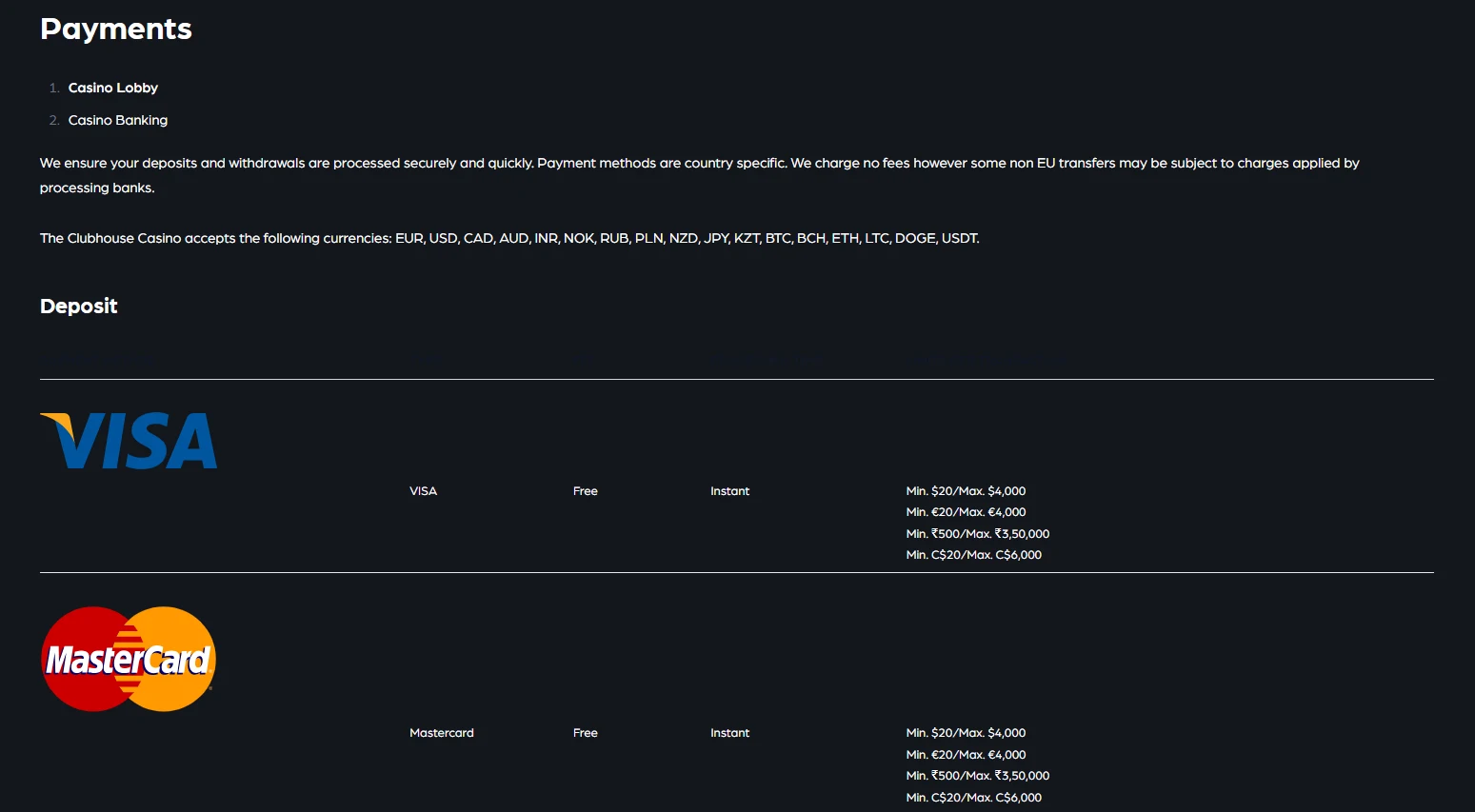
A payment option also needs to be assessed as a round trip, not just a way to add funds. Visa and Mastercard are widely accepted for deposits, but a specialist review notes that card withdrawals may be slower or unavailable, depending on the processor. POLi should not be treated as a cash-out method. A separate withdrawal route may be needed, and its conditions should be clear before funds are deposited.

I have seen “top” do too much work in a heading. It cannot establish an operator’s legal status or payout record. Australian law prohibits operators from providing real-money online casino games to people in Australia; a foreign licence does not change that. Payment convenience does not resolve the legal issue.
For any payment information being assessed, the useful questions are concrete: are the recipient details consistent, is the reference requirement explicit, and are withdrawal arrangements stated rather than implied? A polished deposit screen is not the whole picture.
Do Australian online casinos support PayID withdrawals?
Some operators offer PayID withdrawals, but Australian law prohibits operators from providing real-money online casino games to people physically in Australia.
What are the minimum and maximum deposit limits at PayID casinos?
Casino minimum deposits commonly start at AUD 10–20, with some as low as AUD 5. PayID transaction limits are set by your bank; major Australian banks commonly allow AUD 1,000–5,000 per transaction and AUD 10,000–20,000 per day.
How long do PayID deposits take?
PayID deposits typically reach the casino within 3–15 seconds. They may take longer to be credited if the payment reference is missing the player ID or username.
Can you withdraw casino winnings using PayID?
Some operators offer PayID withdrawals, generally after reviewing and approving the request. Australian law prohibits operators from providing real-money online casino games to people physically in Australia.
How long do withdrawals take?
At top-rated PayID casinos, verified withdrawal requests are typically reviewed and approved within 2–6 hours. After approval, PayID payouts may arrive within minutes to hours; bank transfers and card withdrawals often take one to five business days.
Published by the Clubhouse Casino team.